Only one person knows how to touch it
The system works, but all the knowledge sits in one person's head — and that person is about to leave, is retiring, or has already gone.

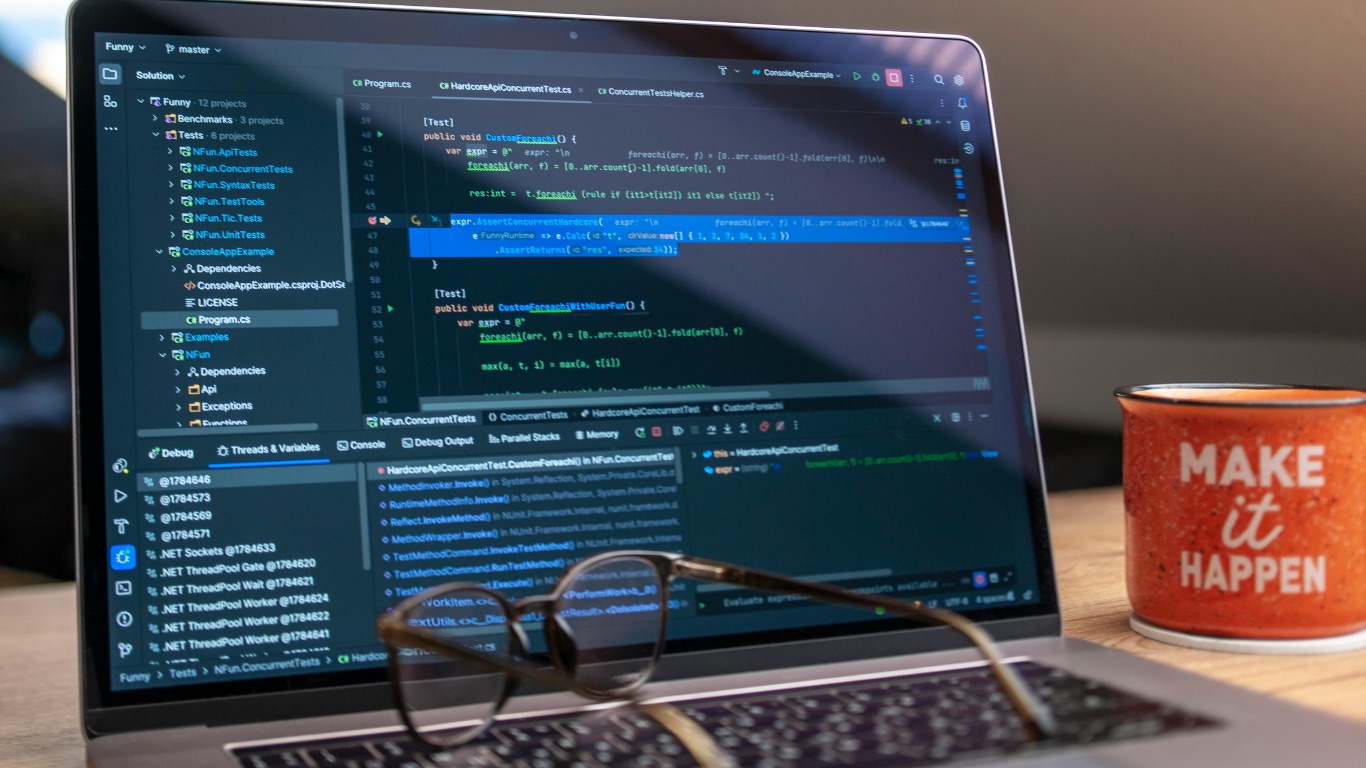
We build, modernize and support mission-critical applications — from a new cloud platform to the VB6 system that still closes billing every month.
Nobody really calls asking for “software engineering”. They call because of one of these four problems.
The system works, but all the knowledge sits in one person's head — and that person is about to leave, is retiring, or has already gone.
A small change takes weeks, requires testing everything by hand, and even then nobody sleeps well on release day.
The version no longer receives security patches, auditors have started flagging it and contract renewal has become a board-level topic.
The backlog grows faster than the team, and hiring and training someone won't solve it within the timeframe the business needs.
They cover the full life cycle of a corporate system: being born, evolving, ageing and being reborn without ever stopping.
01
Corporate platforms, web applications and digital products built to scale — and to be maintained by another team later, if that's the case.
02
From API encapsulation to a full rewrite, choosing the path by the risk the operation is willing to take — not by what is more fun to code.
03
Fixes, adaptation to business changes and planned evolution, with the system owned by people who know both the code and the process.
04
Architecture review, test coverage and TDD/DDD practices in code that never had either.
The market talks about “legacy system modernization” without ever saying which systems it means. We'll say it: VB6, Oracle Forms, Delphi, old .NET Framework, PHP with no framework, undocumented databases and business rules that exist only inside the code.
We support these environments while they are being modernized. Nobody has to switch off what runs billing in order to start moving away from it — and no modernization begins before the operation is covered.
Everyone lists the five. Almost nobody says when each one is the right call — and when it is an expensive mistake. The decision comes from the technical assessment, not from architectural preference.
Rehost
Makes sense when the problem is the server, not the software: end-of-life hardware, a datacenter being shut down, high infrastructure cost.
It's a mistake when the real annoyance is the code. Moving it elsewhere doesn't fix what hurts.
Replatform
Makes sense to change database, operating system or runtime version, gaining support and security without rewriting business rules.
It's a mistake when the architecture won't hold the volume ahead — it postpones the problem by a year or two.
Refactor
Makes sense when the business rules are good and the code is bad. It improves structure and tests while preserving the behaviour the operation knows.
It's a mistake without test coverage before starting: refactoring blind is rewriting without admitting it.
Rebuild
Makes sense when the business process has changed so much that the current system gets in the way more than it helps, or when the technology has no viable path forward.
It's a mistake most of the times it gets chosen — it tends to be an emotional decision, and it is the longest and most expensive path.
Replace
Makes sense when what the system does is not a competitive differentiator and an off-the-shelf product solves it.
It's a mistake when the specific rule of your operation is exactly what sustains your margin. Customizing the product then costs more than keeping your own.
In practice, almost every project combines more than one path — encapsulating one part behind an API, refactoring another and replacing a third. See also when it is worth rewriting a legacy system.
Most of our clients run Sistemas Senior, and much of corporate engineering happens around it: customizations, satellite systems, integrations and automations the ERP alone doesn't cover.
The care that makes the difference is building it without making version upgrades unviable. A badly anchored customization turns every ERP upgrade into a new project — and the bill arrives a few years later, always at the worst moment.
When the topic becomes metrics rather than process, the natural path is our Business Intelligence consulting: same data source, same team.
Predictability and traceability don't come from tools, they come from routine. Ours combines agility in execution with governance in accountability.
Design Thinking and process mapping up front, so the software solves the right problem — not just what was asked for.
Fixed-scope cycles with a demo at the end of each one. The client course-corrects every two weeks, not at final acceptance.
Automated tests and domain-driven modelling on critical rules, where an error is expensive and maintenance pays for itself.
Schedule, risks and accountability following PMI principles, with end-to-end traceability — what regulated sectors require in an audit.
Our team includes professionals certified in agile methodologies and project management, and squads are led by senior consultants — the same seniority that sustains the predictability mission-critical environments demand.
We move fluidly between old environments and modern stacks. This isn't a résumé list: it is what allows us to support a VB6 system and, alongside it, build the platform that will replace it.
We work with Microsoft Azure and AWS on migration and modernization projects, choosing the cloud by what the client already has and what the operation requires — not by our own preference.
A delivered project is not a solved system. Support covers what comes next, at three levels, with an agreed service catalogue and a governance routine with periodic reporting.
Incidents, errors and unexpected behaviour. Ticket-based service, with priorities agreed in the contract.
Change coming from outside in: a new tax rule, an ERP version, an integration whose contract changed, an audit requirement.
Planned improvements in a backlog, prioritized with the client within the contracted monthly hours.
The choice depends on who drives the product. If the vision is yours and you need hands, we embed a team. If the delivery is ours end to end, we fix the scope.
EMBEDDED SQUAD
Senior squads and specialists embedded in your operation, adapting quickly to your process and stack. Product management stays with you.
FIXED-SCOPE PROJECT
For building or modernizing with a clear objective. It comes out of a technical assessment with scope, architecture and schedule agreed.
MONTHLY SUPPORT
Corrective, adaptive and evolutionary work with monthly hours and periodic governance, for systems that need an owner after delivery.
More than two decades leading mission-critical projects, in sectors that answer to auditors: healthcare, public sector, financial services, agribusiness, manufacturing, logistics, retail and infrastructure.
Domestic and multinational clients
Hours of software development and systems engineering
Hours of consulting and process intelligence
In most cases, gradually. A rewrite from scratch is the longest and most expensive path, and it tends to be chosen out of fatigue with the current system rather than analysis. Modernizing in parts — encapsulating what works behind an API and replacing module by module — keeps the operation running and allows stopping midway if priorities change. The technical assessment exists to answer this with data, not opinion.
Yes, and that is how we work. The current system stays supported while the new one is built alongside it, with both coexisting until each part is switched over. No modernization starts before support for what is live is covered.
That is the most common scenario we receive. The first job is rebuilding understanding: reading the code, mapping the rules that exist only inside it, talking to the people who operate it and documenting what we find. That documentation stays with you, even if the project stops there.
It is, and many serious companies still depend on it. The risk isn't the system failing overnight — it is the combination of missing security patches, scarce professionals and dependence on a single person. We support these environments with our own team and, in parallel, design the exit at a pace the operation can absorb.
It depends on the size of the system, the quality of what exists and which of the five paths is chosen — and the difference between them is large. That is why we start with a technical assessment: it turns the question into scope, and scope into a budget.
At three levels: corrective for incidents, adaptive for external changes (tax rules, ERP versions, changed integrations) and evolutionary for planned improvements. The service catalogue and priorities are agreed in the contract, with periodic governance reporting.
Yes. Much of our engineering happens around the ERP — customizations, satellite systems and integrations — with particular care not to make version upgrades unviable. We have a long track record with Senior Sistemas and also work in other environments.
You do. The source code, documentation and project artefacts belong to the client, delivered in a repository under your control. No part of the delivery depends on any proprietary tool of ours to keep running.
FIRST STEP
We analyse the system that is bothering you — architecture, dependencies, risks and the real state of the code — and deliver a written assessment with the possible paths, the effort of each and our recommendation. You decide what to do with it, with us or without.
Talk to a consultant